
 EN
EN


The Size-Performance Tradeoff
Construction and landscaping equipment decisions often default to larger machines under the assumption that more capacity equals better capability. The reality is more nuanced. A mini loader and a full-size loader serve overlapping but distinct roles, and selecting the wrong size wastes capital, fuel, and maneuverability.
Defining the Machine Classes
A mini loader typically operates in the 1,200- to 2,000-pound rated operating capacity range with machine weight under 5,000 pounds. Compact dimensions — often under 48 inches wide — allow access through standard gates and doorways where full-size equipment cannot pass. Tracked configurations provide ground pressure as low as 3 to 4 psi, minimizing turf damage on finished landscapes.
Full-size loaders range from 2,000 to over 4,000 pounds rated capacity with machine weights from 7,000 to 12,000 pounds. The additional capacity handles heavier attachments — cold planers, large augers, and grapple buckets — that mini loaders cannot lift safely. The trade-off is ground pressure exceeding 6 psi for wheeled machines and widths from 60 to 80 inches that restrict access.
Application Matching
A mini loader excels in landscaping, residential construction, and interior demolition where access constraints and surface protection determine machine selection. Running conduit through a finished backyard requires navigating a 42-inch gate, crossing a paver patio without cracking stones, and lifting a 350-pound trenching attachment — all within the mini loader's capability. A full-size loader on the same job would require removing fence sections and protecting the patio with plywood sheets, adding labor cost that cancels the productivity advantage. The value of a mini loader in these scenarios is not measured in lifting capacity but in damage prevention and access capability.
Full-size loaders dominate in commercial construction and agricultural material handling where lifting capacity determines daily productivity. Moving 2,500-pound pallets of retaining wall block is a five-minute task for a full-size loader and impossible for a mini loader rated at 1,500 pounds.
Ownership Cost Comparison
A new mini loader costs approximately 50 to 65 percent of an equivalent full-size machine. Fuel consumption scales with weight — a mini loader consumes 1.5 to 2.5 gallons per hour versus 3 to 5 gallons for full-size. Over 1,200 hours annually, this represents 3,000 to 5,000 in fuel savings. Track replacement further differentiates the classes — mini loader tracks cost 1,500 to 2,500 per set versus 3,500 to 5,500 for full-size.
A Practical Case: Landscaping Contractor Fleet Decision
A residential landscaping contractor operating five crews needed to replace two aging full-size loaders. Analysis of job tickets revealed the machines operated at less than 50 percent of rated capacity on 80 percent of jobs. The heavy machines caused $4,200 annually in turf repair costs on finished landscapes.
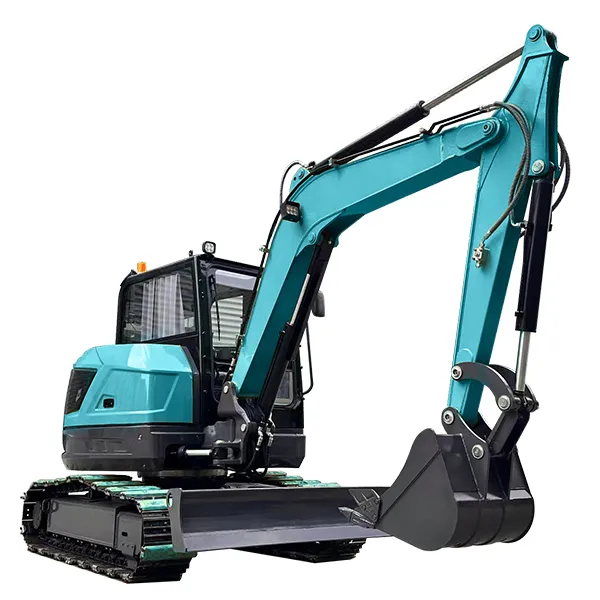
The contractor replaced both with mini loaders from Jining Aide Machinery, selecting 1,600-pound rated tracked models. The new mini loader fleet eliminated turf damage costs entirely, reduced fuel consumption by 40 percent, and accessed rear-yard work sites without fence removal. The capability gap — occasional pallet handling exceeding 1,500 pounds — was covered by scheduling deliveries when a rented full-size loader was available.
Selection Framework
Evaluate the actual weight of commonly handled materials over a three-month period — not the heaviest occasional lift. Measure the narrowest access point on typical job sites. Calculate annual fuel and maintenance at projected operating hours for each class. A mini loader that handles 80 percent of jobs with lower total cost of ownership is the correct financial decision, supplemented by rental for the remaining 20 percent. For contractors operating in both open construction sites and finished residential landscapes, a mixed fleet of one full-size loader for heavy lifting and one mini loader for access-constrained work often provides better overall utilization than two same-size machines of either class.
Frequently Asked Questions
What is the lifting capacity difference between mini and full-size loaders?
Mini loaders handle 1,200 to 2,000 pounds. Full-size loaders handle 2,000 to over 4,000 pounds. The capacity overlap around 2,000 pounds is where machine dimensions, ground pressure, and access constraints become the deciding factors rather than raw lift capacity.
Can a mini loader use the same attachments as a full-size loader?
Mini loaders use compact attachments with narrower mounting plates — 36 to 42 inches versus 48 to 66 inches. Universal quick-attach plates are available on models from manufacturers like Jining Aide Machinery.
How does ground pressure compare between mini and full-size track loaders?
Mini loaders achieve 3 to 4 psi. Full-size tracked loaders achieve 4 to 6 psi. The difference matters on turf where visible track damage affects customer satisfaction.
Is a mini loader suitable for demolition work?
Interior demolition with restricted access is an ideal application. Structural demolition requiring handling of debris exceeding 1,500 pounds requires full-size equipment.
What is the expected service life difference between mini and full-size loaders?
Both classes achieve 5,000 to 8,000 hours before major overhaul with proper maintenance. Mini loaders in lighter-duty applications often accumulate hours more slowly, extending calendar life.
Are mini loaders available with enclosed cabs?
Enclosed cabs with climate control are available on mid-range models. The smallest 1,200-pound capacity class typically offers open ROPS canopies due to weight constraints.